
Embarking on Japanese joinery? Discover a rich tradition! Resources like PDFs – “Wood Joints in Classical Japanese Architecture” – and books,
such as “The Complete Japanese Joinery” by Hartley & Marks, offer excellent starting points for novices.
What is Japanese Joinery?
Japanese joinery (mokuzō) is a wood joining technique that historically made nails and glue secondary, or even entirely unnecessary. It’s a craft focused on precisely cut, interlocking pieces, showcasing incredible artistry and structural integrity. Beginners often seek a “beginner’s guide to Japanese joinery PDF” to understand these complex connections.
Unlike Western joinery, which often relies on fasteners, Japanese joinery emphasizes the inherent qualities of the wood itself. The techniques, refined over centuries, demand meticulous layout and precise execution. Resources like scanned PDFs, though sometimes imperfect in image quality, provide valuable visual examples of these joints.
Understanding the principles behind these joints – tsugite and shiguchi being fundamental – is key. Many enthusiasts recommend starting with visual guides, readily available online, to grasp the core concepts before attempting construction.
Historical Significance of Japanese Woodworking
Japanese woodworking boasts a profound history, deeply intertwined with the nation’s architectural and cultural evolution. Temples, shrines, and traditional homes showcase centuries of refined techniques, often documented in resources sought after by beginners – a “beginner’s guide to Japanese joinery PDF” being a popular starting point.
Historically, the scarcity of metal in Japan fostered a reliance on wood and ingenious joinery methods. This necessity spurred innovation, resulting in a system prioritizing precision and the natural properties of wood. Early texts and architectural drawings, now sometimes available as scanned PDFs, reveal the sophistication of these ancient practices.
The craft wasn’t merely functional; it was an art form, reflecting philosophical principles of harmony and respect for materials. Studying its history provides context for understanding the techniques detailed in modern guides.
Why Learn Japanese Joinery?
Embarking on Japanese joinery offers numerous rewards. Beyond crafting beautiful and durable objects, it cultivates patience, precision, and a deep connection with wood. Many beginners start with accessible resources like a “beginner’s guide to Japanese joinery PDF” to grasp fundamental concepts.
The techniques emphasize efficient material use and structural integrity, offering sustainable building practices. Learning these joints fosters problem-solving skills and an appreciation for traditional craftsmanship. Resources like Hartley & Marks’ “The Complete Japanese Joinery” provide detailed examples.
It’s a meditative practice, promoting mindfulness and a unique artistic expression. Whether seeking a new hobby or professional skill, Japanese joinery provides a fulfilling and enriching experience.

Essential Resources: Finding a “Beginner’s Guide to Japanese Joinery PDF”
Locating a PDF guide is possible! Explore online archives, library sites, and even torrents for scanned copies of valuable resources like architectural joint guides.
Availability of PDF Resources Online
Digital access to Japanese joinery knowledge is growing, though finding a dedicated “beginner’s guide” in PDF format can require some searching. Several sources offer valuable materials. A readily available option is “Wood Joints in Classical Japanese Architecture,” accessible via a direct link (https://fabiap.files.wordpress.com/2011/01/wood-joints-in-classical-japanese-architecture.pdf).
However, be aware that many PDFs are scanned copies, potentially exhibiting slight imperfections like crooked pages. Despite this, the text remains clear and legible. Furthermore, online communities frequently share information about locating resources on torrent sites or archive platforms. Keep in mind that availability fluctuates, so consistent searching is key.
The internet provides a wealth of information, but verifying the source and quality is always recommended.
Recommended Books: “The Complete Japanese Joinery” by Hartley & Marks
“The Complete Japanese Joinery” by Hartley & Marks is highly recommended by experienced carpenters like Takami Kawai as an excellent resource for beginners. While currently expensive to purchase new online, it remains a cornerstone text for understanding traditional techniques. The book excels in providing detailed example images of various joinery methods, aiding visual learners immensely.
Although finding a new copy can be costly, resourceful individuals have located PDF versions on torrent sites and library archive platforms. These PDFs are often scanned copies, meaning some pages may be slightly askew, but the textual content remains clear and usable.
Its value lies in its comprehensive coverage of joinery principles.
Free PDF Options: “Wood Joints in Classical Japanese Architecture”
For those seeking accessible learning materials, “Wood Joints in Classical Japanese Architecture” is readily available as a free PDF download. A direct link – https://fabiap.files.wordpress.com/2011/01/wood-joints-in-classical-japanese-architecture.pdf – provides immediate access to this valuable resource. This option is particularly appealing for beginners on a budget or those preferring digital learning formats.
The document offers a detailed exploration of traditional Japanese wood joinery, focusing on the joints used in classical architecture. It’s a fantastic supplement to other learning materials, providing a deeper understanding of historical construction methods.
This resource embodies the collaborative spirit of online communities!

Core Concepts & Techniques
Mastering joinery demands understanding wood characteristics, precise layout, and utilizing traditional Japanese tools – essential skills detailed in guides and PDFs for beginners.
Understanding Wood Characteristics in Japanese Joinery
Japanese woodworking deeply respects wood’s natural properties. Unlike methods prioritizing force against the material, this tradition emphasizes working with the grain, understanding shrinkage, and recognizing variations between species. Beginners exploring PDFs like “Wood Joints in Classical Japanese Architecture” will quickly grasp this core principle.
Different woods behave uniquely; selecting the appropriate timber for a specific joint is crucial. Resources, including Hartley & Marks’ “The Complete Japanese Joinery,” detail how wood movement impacts joint longevity.
Understanding moisture content and seasonal changes is paramount. A beginner’s guide PDF should highlight the importance of properly drying wood to prevent warping or cracking, ensuring stable and enduring joinery. Careful observation and respect for the material are fundamental.
Layout and Precision in Japanese Woodworking
Accuracy is paramount in Japanese joinery. Unlike relying heavily on power tools, this craft prioritizes meticulous layout and hand-tool precision. A beginner’s guide PDF, even a scanned copy with slightly crooked pages, will demonstrate the importance of careful marking and measuring.

Traditional techniques emphasize using tools like sumi-gata (layout squares) and precise marking gauges. Resources like “The Complete Japanese Joinery” by Hartley & Marks illustrate these methods.
Even slight errors can compromise a joint’s integrity. Beginners should focus on developing a keen eye for detail and practicing consistent, accurate layouts. PDFs showcasing joint examples provide visual references for achieving tight, seamless fits.
Traditional Japanese Woodworking Tools
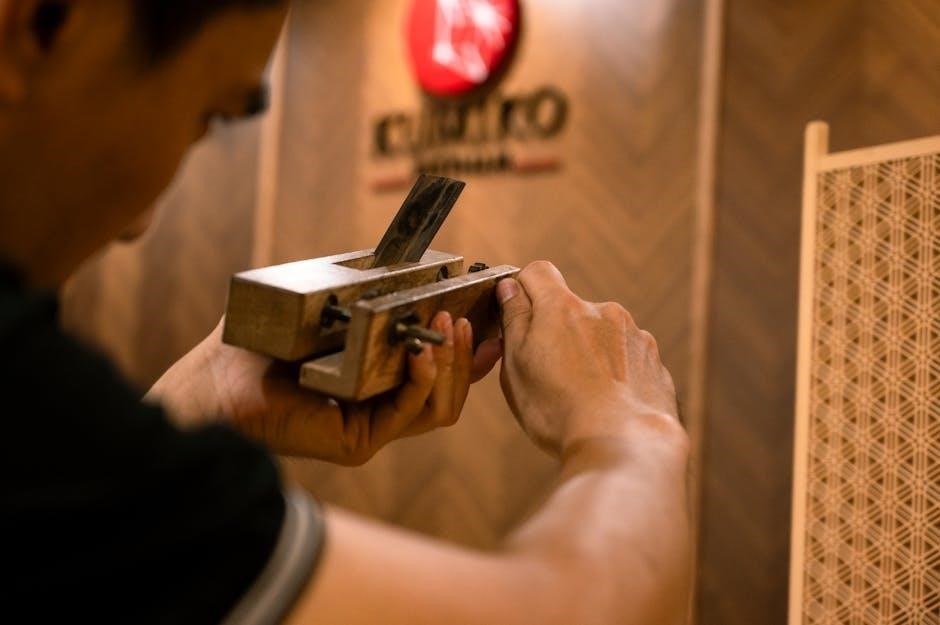
Japanese joinery utilizes a specialized toolkit. A beginner’s guide to Japanese joinery, often found as a PDF, will introduce essential tools beyond typical Western sets. Expect to encounter nokogiri (saws), kanna (planes), and various chisels – nomi.
These tools are often crafted from high-carbon steel, requiring regular sharpening and maintenance. Online resources and PDFs emphasize the importance of tool care for optimal performance.
While modern alternatives exist, mastering traditional tools unlocks the nuances of the craft. “Tools of the trade” – both traditional and modern – are key to understanding Japanese woodworking techniques. Learning to tune and maintain these tools is a continuous process.

Fundamental Joinery Joints
Mastering joints is crucial! A beginner’s guide to Japanese joinery PDF highlights Tsugite (end joints) and Shiguchi (right angle joints) as foundational techniques.
Tsugite (End Joints): A Detailed Look
Tsugite, or end joints, represent a cornerstone of Japanese joinery, frequently appearing in beginner’s guides and PDF resources. These joints connect wood pieces end-to-end, demanding precision for structural integrity and aesthetic appeal. A comprehensive understanding begins with recognizing the various Tsugite forms, each suited for specific applications.
Beginner PDFs often illustrate basic Tsugite variations, emphasizing the importance of tight fits achieved through meticulous hand-tool work. The joint’s strength relies on the precise shaping of the wood fibers, interlocking them to resist shear forces. Learning to accurately lay out and execute these cuts is paramount; Resources like those by Nakahara detail the process, showcasing how traditional techniques ensure longevity and stability in wooden structures. Mastering Tsugite provides a solid foundation for tackling more complex joinery challenges.

Shiguchi (Right Angle Joints): Types and Applications
Shiguchi, translating to right-angle joints, are fundamental in Japanese woodworking, frequently detailed in beginner’s guides and downloadable PDFs. These joints connect wood pieces at 90-degree angles, forming the framework for structures. Several Shiguchi types exist, each offering unique strengths and aesthetic qualities.
Beginner resources often focus on simpler Shiguchi variations, emphasizing clean cuts and precise fitting. PDFs showcase how these joints are used in framing, furniture construction, and architectural elements. Understanding the nuances of each type – like the Okuriari Shiguchi – is crucial. Nakahara’s work highlights the importance of wood grain orientation and the use of wedges for added strength. Mastering Shiguchi is essential for building stable and visually appealing wooden creations, forming a core skill for any aspiring joiner.
Advanced Joinery & Construction
Progressing beyond basics? Explore Jiku Gumi framing, gable roof construction, and traditional flooring techniques detailed in comprehensive guides and available PDFs.
Jiku Gumi (Framing): Principles and Techniques
Jiku Gumi represents a cornerstone of traditional Japanese timber framing, emphasizing a post-and-beam system secured with intricate joinery – eschewing nails and screws whenever possible. Understanding this system requires delving into the principles of load distribution and structural integrity, often visualized through detailed diagrams found in resources like “The Complete Japanese Joinery” by Hartley & Marks, available as a scanned PDF online.
These PDFs and books illustrate how posts (ryū) and beams (bari) interlock, creating a robust framework. Key techniques involve precise mortise-and-tenon joints (shiguchi and tsugite) adapted for framing purposes. Successfully implementing Jiku Gumi demands meticulous layout, accurate cutting, and a deep appreciation for wood’s natural characteristics. Beginners can benefit from studying examples of existing structures and practicing smaller-scale framing exercises before tackling larger projects.
Japanese Style Roof Framing: Gable Construction
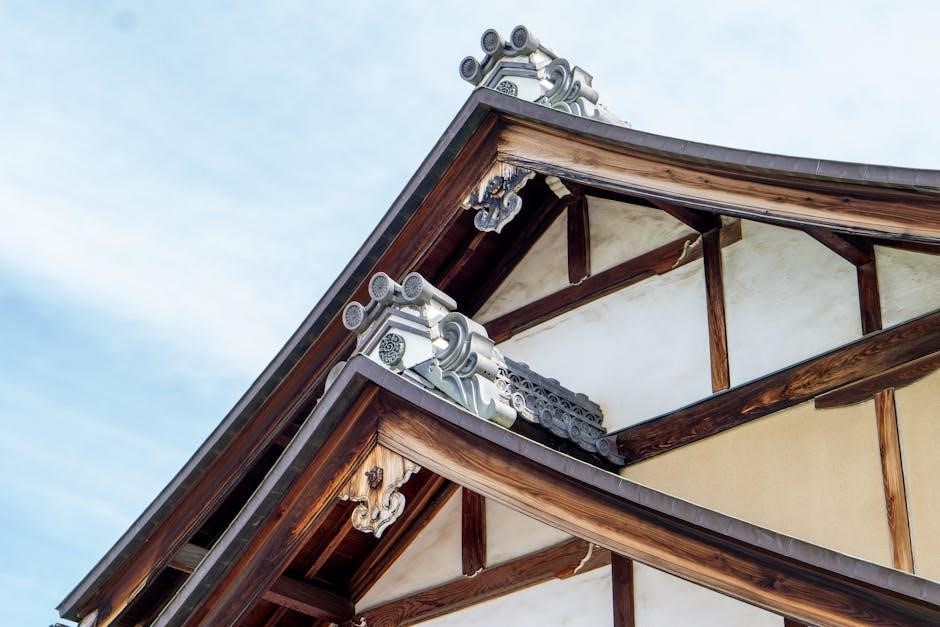
Gable roof framing in traditional Japanese architecture showcases remarkable ingenuity, relying heavily on precisely fitted timber components and joinery. Resources like scanned PDFs of “The Complete Japanese Joinery” by Hartley & Marks detail the assembly of hip rafter assemblies and gable structures. These resources visually demonstrate the complex interplay of rafters (nodaji), ridge beams (mune-bari), and purlins (haruneri).
Unlike Western framing, Japanese gable construction often employs a unique system of interlocking joints, minimizing the need for metal fasteners. Understanding the angles and cuts required for these joints is crucial, and beginner’s guides often emphasize the importance of accurate layout and careful execution. Studying diagrams and examples within these PDFs will illuminate the principles of weight distribution and structural stability inherent in this time-honored building method.
Flooring Construction in Traditional Japanese Homes
Traditional Japanese flooring, known as tatami, rests upon a carefully constructed wooden substructure. Beginner’s guides, including downloadable PDFs like those referencing Yasua Nakahara’s work, highlight the importance of jiku gumi (framing) in supporting this system. The floor joists (taruki) are meticulously joined using techniques like tsugite (end joints) and shiguchi (right angle joints), minimizing reliance on nails or screws.
These PDFs often illustrate how the spacing and arrangement of joists contribute to both structural integrity and the desired aesthetic. Understanding the principles of wood movement and incorporating expansion gaps are also key considerations. Resources like “The Complete Japanese Joinery” provide detailed examples of these joints, enabling beginners to replicate these techniques and appreciate the craftsmanship involved.
Fasteners & Finishing
Traditional Japanese joinery prioritizes wood connections, minimizing fasteners. PDFs by Nakahara detail various types, while finishing techniques, like hikarikata (reproduction methods), enhance beauty.
Various Types of Fasteners Used in Japanese Joinery
While celebrated for its often fastener-less approach, traditional Japanese joinery isn’t entirely devoid of them. Understanding these supplemental elements is crucial, even for beginners. Resources like Nakahara’s work, often found as a PDF, detail their nuanced applications.
Historically, wooden pegs – kugi – were paramount, securing joints like tsugite and shiguchi. These weren’t merely functional; their placement and material contributed to the aesthetic. Bamboo pins also saw use, offering flexibility. Metal fasteners, though less common, existed, particularly in larger structures or for reinforcement.
Modern practice sometimes incorporates screws, but purists emphasize minimizing their visibility. The goal remains a seamless integration of materials, where the joinery itself provides primary strength. Exploring PDF guides and books illuminates these subtle, yet significant, details.
Finishing Eave Ends: Traditional Methods
Protecting eave ends was paramount in traditional Japanese construction, demanding meticulous craftsmanship. Resources like scanned PDFs of older texts reveal techniques focused on weather resistance and aesthetic harmony. These methods often involved carefully shaped wood components, extending beyond the structural supports.
Hikarikata, or reproduction methods, played a role, ensuring consistent detailing. Skilled carpenters would create layered overhangs, diverting rainwater away from the building’s core. Specific wood choices, naturally resistant to decay, were favored.
Finishing wasn’t solely about protection; it was an art form. Subtle curves and precise cuts defined the eave’s silhouette. Studying examples in books like “The Complete Japanese Joinery” provides insight into these refined techniques, even when accessed via digital PDFs.
Reproduction Methods (Hikarikata)
Hikarikata, the art of replication, was crucial in Japanese joinery, ensuring consistency across projects and preserving traditional techniques. Studying detailed diagrams – often found within scanned PDFs of classic texts – reveals how carpenters meticulously copied existing joinery. This wasn’t simple imitation; it involved understanding the underlying principles.
Beginners can benefit from analyzing these reproduced joints, learning to deconstruct complex forms into manageable steps. Resources like “The Complete Japanese Joinery” by Hartley & Marks showcase examples, even if sourced from online PDFs.
Hikarikata demanded precision and a deep understanding of wood behavior. It wasn’t just about recreating the look but also the structural integrity of the original.

Further Exploration
Dive deeper! Explore stereotomy’s link to Japanese joinery, and refine your skills by utilizing resources for tool tuning and maintenance, found in PDFs.
Stereotomy and its Relevance to Japanese Joinery
Stereotomy, the art of cutting stones, surprisingly connects to Japanese joinery. While seemingly disparate, both disciplines demand precise three-dimensional thinking and an understanding of geometric relationships. Japanese joinery, renowned for its intricate wood connections, shares this spatial reasoning with stereotomy.
Understanding how angles and planes intersect is crucial in both crafts. Beginner resources, including PDFs like those detailing classical Japanese architecture, often showcase joints that implicitly demonstrate stereotomic principles. The careful layout and precise cuts required aren’t just about wood; they’re about visualizing and executing complex forms in three dimensions.
Exploring stereotomy can enhance a joiner’s ability to anticipate how pieces will fit, improving accuracy and design capabilities. It provides a broader perspective on structural integrity and the beauty of interconnected elements, enriching the learning experience beyond simply following a “beginner’s guide to Japanese joinery PDF.”
Resources for Tuning and Maintaining Tools
Sharp tools are paramount in Japanese joinery. A “beginner’s guide to Japanese joinery PDF” won’t fully prepare you for the importance of tool maintenance. Traditional Japanese tools, while exquisite, require regular tuning to perform optimally. Fortunately, a supportive online community exists, eager to share knowledge.
Experienced carpenters, like Takami Kawai, emphasize tool care. Online forums and subreddits dedicated to woodworking offer invaluable advice on sharpening, adjusting, and repairing tools. Learning to properly maintain your tools extends their lifespan and dramatically improves the quality of your work.
Don’t underestimate the value of learning from others; many seasoned practitioners are willing to “give back” their expertise. Investing time in tool maintenance is as crucial as studying joinery techniques themselves, ensuring a rewarding and precise woodworking journey.